Abandoned by Their Ally and Forced to Fight: US Foreign Policy Reversal Leaves Kurdish Militia Alone Against Turkish Forces
As of
October 6th, President Trump instructed all American military
personnel to leave the North Syrian-Turkish border. President Trump was quoted
in saying that it is time for us to get out and let others figure the situation
out. The “situation” that President Trump is referring to is the conflict in
Syria over territorial and power control in the region, particularly the opposing
forces of the Kurds, Turkey, Bashar al-Assad’s regime, and Islamic extremists.
The Kurdish militia have aided the efforts of the United States military to
eliminate the spread of Islamic extremists and terrorism in the region since
the Obama administration. The Kurds and the US military have also fought
against Bashar al-Assad’s dictatorial regime in order to prevent ethnic
cleansing in Syria. Now all of a sudden, President Trump has reversed our
support of the Kurds and pulled out all US military support from the region.
Just a few days after the initial announcement, the Turkish government ordered an
invasion of the Kurdish-controlled region of Syria. The original Kurdish
militia was a group that promoted insurrection within Turkey. While the current
Kurdish militia, a part of the Syrian Democratic forces, is no longer what it
once was, Turkish President Recep Erdogan views the Kurds as terrorists and has
long threatened to invade Kurdish territory.
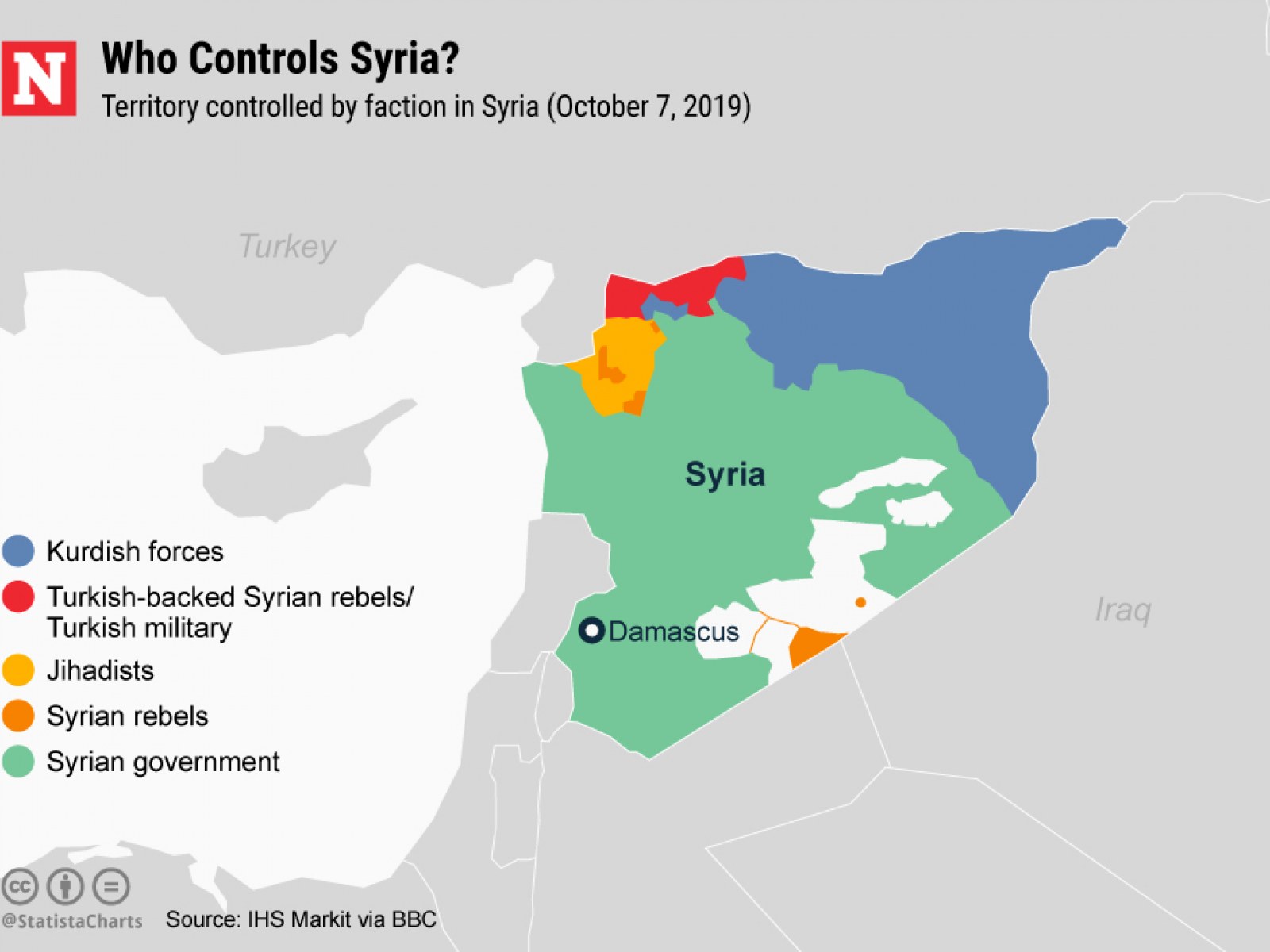
This map shows how the territorial control of Syria is divided by the various actors involved.
This
sudden reversal of US foreign policy has already had dramatic implications in the
conflict in Syria. Without the support of US troops, Kurdish forces have been forced
to abandon prisons that hold over 10,000
Islamic State fighters. To make matters worse, two unnamed US officials
have discovered that Turkish-supported fighters have begun to deliberately
free these Islamic State fighters from their prisons, which now makes our
fight against terrorism even more difficult. The situation is quickly deteriorating
and now not only does Turkey stand to gain from this but Assad’s regime, Iran,
and Russia as well. Iran and Russia have been staunch defenders of Assad’s
regime and now that the Kurds are facing a seemingly inevitable slaughter, this
could mean that Assad’s regime will seek to take control of the region. Senator
Chris Murphy, a Democrat from Connecticut and member of the Foreign Relation
Committee, stated that splitting
NATO is a huge win for Russia. Turkey is a NATO ally, but the Kurds have
greatly aided in our war against terrorism so now the US is facing a
significant dilemma. Division amongst NATO allies does nothing but aid in the
efforts of countries such as Russia to gain power.
Members
of Congress on both sides have been swift to condemn President Trump’s actions.
Even some of his most unwavering supporters such as Republican Senator Lindsay
Graham did not hesitate to label President Trump’s decision as sickening
and shameful. Congress is seemingly moving quickly to approve a set of
economic and military sanctions on Turkey in response to their invasion of
Kurdish territory in Syria. Several
NATO allies such as France, Germany, Norway, and the Netherlands have
already announced they are ending the sale of arms to Turkey. As discussed in
class on Monday, there seems to be plenty of unorthodox lawmaking occurring in
Congress at the moment due to the severity of the situation. It is likely that
much of the proposed sanctions have been worked out informally within groups
behind closed doors. This kind of policymaking is also due to the fact that as
each day passes, more Kurds will be killed and the potential of Assad and his
allies growing in power rises exponentially. As of today, the proposed sanctions
have not yet been passed but it seems to be the goal of Congress to enact said
sanctions as soon as possible. It is rare that a policy decision by the
President is criticized so intensely by members of both parties. Due to this
bipartisan uproar, this should be one of those instances that there will be no
real resistance in the passing of policy in a divided Congress. This situation
changes by the hour so it remains to be seen if the Kurds will be able to fight
off the invading Turkish forces before they are annihilated, even if the
Congressional-supported sanctions are enacted.
You do a really nice job analyzing the impacts of U.S. withdrawal on foreign relations and domestic politics. I agree that not only is it dangerous for us to leave the Kurds who have protected prisons holding ISIS fighters, but to break promises to our allies damages our national integrity and reliability. I think you also do a good job highlighting the precarious situation we and Turkey are in as NATO members and how other countries have responded to Turkey’s aggression in Syria. When legislators of the president’s party so heavily criticize the president, it makes for an interesting opening of bipartisan cooperation in Congress.
ReplyDeleteFirst, I would like to say you capture the heart of the issue very well with complex alliances intermingling within Syria, as well as the policy making steps that Congress has taken in regards to sanctions. Also, you note the issues of Russian entanglement which is a longstanding issue with PMCs in the area as well as material, equipment, and uniformed advisers. The main issue of contention that I want to lend more nuance to is the idea of the Kurds. Western media seems to think the Kurds are an ethnic monolith with similar policy interests and expectations e.g. a united Greater Kurdistan. This really is not the case as the the political histories and development of the various Kurdish populations have led to drastically different outcomes. The Kurdistan Regional Government in Iraq for instance has a closer working relationship with Turkey due to economic interests, and Masoud Barzani cooperating to remove the PKK/YPG militants from Northern Iraq in 2015. The Syrian Kurds in Rojava also just recently gained U.S. support unlike the Iraqi Kurds which gained support as part of wider Cold War policies in the region in the late 1960s early 70s. There is also a weird bit of history that we should be aware of as well; the Syrians under Hafez al-Assad harbored the PKK within their borders and allowed the militants to launch cross border attacks into Turkey up until 1998. The PYD (Democratic Union Party) in Syria however still uses the ideology of Abdullah Ocalan (leader of the PKK) to some extent. Granted this splitting hairs, but it is important to note the connection between militant factions in Turkey and Syria. There is a decent amount of literature and significant amounts of propaganda to sift through on this subject alone. I highly recommend any works from Denise Natali, Joost Hiltermann, David McDowall, and Michael Gunter to name a few if you're really interested.
ReplyDeleteThis comment has been removed by the author.
ReplyDeleteI appreciate your post regarding the situation in Syria and Trump's action to pull troops out of the country. I believe you do a good job giving the details of the situation and how complicated the alliances are throughout the region of northern Syria. But Although I acknowledge your point of view, and understand where you are coming from I do disagree with a few of your conclusions. Mainly, I would have to disagree with you on your general point that pulling U.S. troops out of Syria was a bad idea. Even though Trump's decision may be seen as "abandoning allies" I believe it was the right move. To what extent is it the United Stats' responsibility to constantly police the rest of the world? When will our military intervention into other sovereign countries end? In my opinion our endless militarism into the Middle East needs to stop, because obviously our presence in these countries has not helped stabilize the region. Just look at the example of Libya and how "safe" the country has been since the U.S. backed overthrow of Gaddafi. It is important note that I am definitely not what you would call a "Trump supporter" and I find myself critiquing his policies constantly, however I do believe he made the right choice in pulling us our of Syria for the simple fact that it is not the United States' responsibility to be meddling in the affairs of other countries
Delete